The Bridgerat of Cossipore
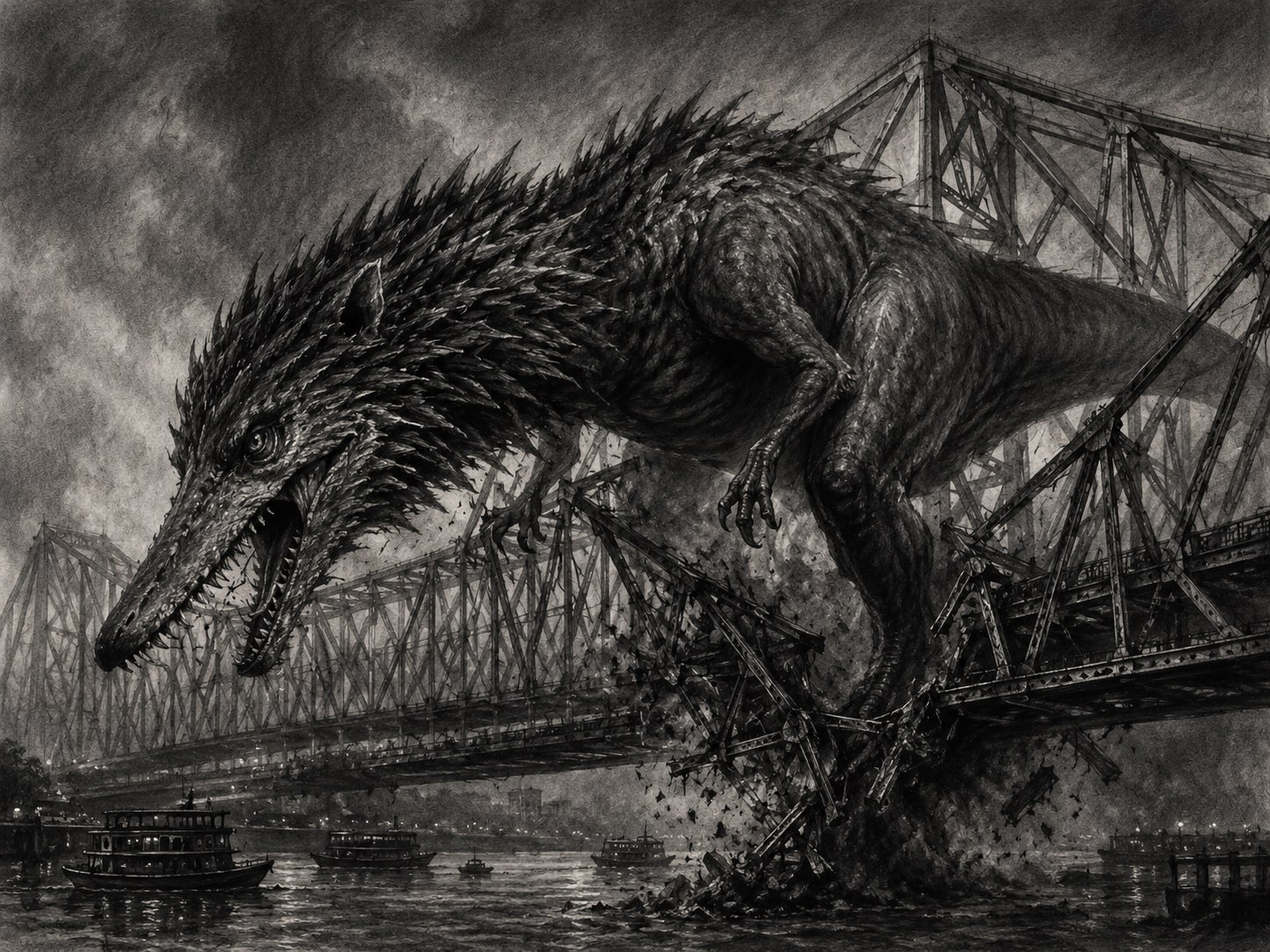
THIS IS A WORK OF FICTION
On the afternoon the first goat vanished from Cossipore Road, the tea stall under the peeling Shyambazar coaching-center poster was doing what Calcutta tea stalls have done since the British discovered bureaucracy and Bengalis discovered complaint: boiling milk beyond forgiveness, serving opinions in glass tumblers, and pretending the future could be understood if only one more person explained it loudly enough.
The rain had stopped ten minutes earlier. Not properly stopped, but paused with that sulky local expression by which rain in Kolkata says, I am not gone, I am merely thinking. Water trembled from tram wires. The pavement smelled of wet dust, diesel, frying telebhaja, and the damp woolliness of old political posters coming loose from walls. A delivery rider in a blue raincoat argued with a pharmacy clerk about a wrong address. Two schoolboys from Cossipore English School stood beneath a balcony blackened by years of incense smoke, sharing one egg roll and three conspiracy theories.
The taller boy, Ishaan Mitra, Class Ten, Section B, carried a schoolbag heavy enough to suggest either academic excellence or smuggling. His friend Bappa had always believed in the second possibility.
“You’re walking like police will catch you,” Bappa said.
Ishaan adjusted the strap. “Don’t talk nonsense.”
“That means yes.”
Across the road, a tea-seller lifted his kettle and shouted, “Who has taken Gopal-da’s goat? In broad daylight! Even thieves have lost manners.”
The missing goat was not a famous goat. It had no political influence, no Instagram page, no uncle in the municipal corporation. But it had been present every day beside the paan shop, chewing cardboard with the calm concentration of a retired judge. Its absence made a small but noticeable tear in the neighborhood.
Bappa pointed toward the narrow lane beside the closed printing press. “Maybe leopard.”
“In Cossipore?”
“Why not? Everything comes to Kolkata eventually. Malls, dengue, vape shops.”
Ishaan did not smile. He looked at the lane, where black water moved sluggishly along the drain. Something had scored the mud there: three long grooves, then a drag mark, then nothing. A torn strip of goat hair clung to a broken plastic crate.
Bappa saw his face. “What?”
“Nothing.”
But inside Ishaan’s bag, beneath his biology textbook, under a brown-paper-covered practical copy, inside a plastic lunchbox that his mother thought contained unfinished luchi, something moved.
Not much.
Just a soft muscular adjustment.
A small, wet scrape.
Like a thought changing shape.
Ishaan lived on the top floor of a four-storey house in Dum Dum that had once belonged to one family and now belonged to eleven, plus one widow who owned the roof by force of moral seniority. The building had a name—Udayan—but the paint had surrendered long ago. Ferns grew from cracks in the stairwell. A shrine to Kali blinked with one exhausted red bulb near the entrance, beside a row of electric meters that looked as if they had survived both empire and lightning.
His mother, Mitali, worked at a diagnostic center near Nagerbazar. She processed bills, reassured patients, fought with labs, and returned home each evening smelling faintly of sanitizer and defeat. She had once wanted to study botany. Life had given her barcode stickers.
“Wash your hands,” she called when Ishaan entered.
“I did.”
“You have not even reached the basin.”
“I meant mentally.”
“Very funny. Board exam is six months away. Your biology marks will not improve by mentally washing hands.”
He carried his bag to the tiny room he called his lab because calling it his bedroom would require acknowledging the bed had become a storage shelf. On the table stood a second-hand microscope, three cracked beakers bought from College Street, a toy centrifuge he had modified until it made a noise like a frightened mixer grinder, and a locked aquarium covered with a bedsheet.
The aquarium had belonged to his father.
That was the fact everything in the room walked around carefully.
Sourav Mitra had taught life science in a government school and died two years ago in a private hospital off VIP Road, where the billing department had survived him with greater vigor than his kidneys. Before the dialysis, before the borrowed money, before relatives stopped answering calls, he had taken Ishaan to Science City and explained evolution beneath a plastic dinosaur with a frozen roar.
“Remember,” Sourav had said, touching the boy’s head, “nature is not a ladder. It is a gossip network. Everybody is related to everybody, but some relatives become unbearable.”
After he died, Ishaan began collecting unbearable relatives.
The amber came first.
Not museum amber. Not the cinematic golden drop with a perfect mosquito trapped like a confession. This was cloudy resin from an online seller in Jaipur, advertised as “Jurassic Mosquito Authentic Fossil Inclusion Very Rare,” which naturally meant it was probably fake, overpriced, and meant for men who bought military watches and self-improvement courses. Ishaan bought it anyway with money saved from tutoring a Class Six boy in fractions.
Under the microscope, the insect inside looked like a mosquito if one were generous, lonely, and willing to ignore several anatomical disagreements. But there was organic residue. Ancient or merely old, he could not tell. It was enough for dreaming.
The rest came from the city.
A dead house lizard from the bathroom window.
Rat tissue from the trap behind the rice tin.
A feather from a kite that had fallen near Belgachia.
Scrap data from pirated genetics software passed around in science-olympiad groups by boys who spoke of CRISPR the way earlier generations spoke of cricket.
And the incubator came from his father’s old aquarium, fitted with heaters, sensors, and a cheap controller ordered from Chandni Chowk.
No single thing should have worked. That was the maddening part. His biology teacher, Ms. Rukmini Sen, would later say this to the police, to the television reporter, and finally to herself in the mirror. Nothing the boy had done should have worked. A child with school equipment and stolen ambition cannot rebuild prehistory in a Dum Dum bedroom. Science is not a magic trick performed with YouTube videos and grief.
But science, like Calcutta, is less tidy than its brochures.
Ishaan did not create a dinosaur. He created an argument.
A thumb-sized body emerged first, translucent and trembling, with a tail like a comma and a head too long for mercy. It should have died. It did not. It grew.
On the third day, it ate boiled egg.
On the fourth, raw fish.
On the fifth, the neighbor’s missing pigeon.
By the eighth day, it had learned to lift the aquarium lid from inside.
By the tenth, it watched him.
Not with the blank bead-eye of a lizard or the startled panic of a rat. It watched with a kind of irritated recognition, as if Ishaan were a poorly performing servant.
He named it Ketu.
He did not tell his mother. Mothers had an irritating habit of introducing morality into scientific progress.
He did tell Ms. Sen, almost.
After class, when the boys were thundering out toward phuchka stalls and tuition, Ishaan lingered with his practical copy open to a neat diagram of mitosis.
“Ma’am,” he said, “suppose DNA is damaged but some pattern remains. Could another organism fill gaps? Like a sentence completed by autocorrect?”
Ms. Sen capped her red pen. She was thirty-four, unmarried in a way that made aunties lower their voices, and dangerously competent. She wore crisp cotton saris, rode the metro, and had the expression of someone permanently disappointed by human reasoning.
“Autocorrect also turns ‘meeting’ into ‘mating,’ Ishaan. Be careful with metaphors.”
He flushed. “I mean theoretically.”
“Theoretically many things are possible. Practically, most are dead, deformed, or illegal.”
“What if the organism survives?”
“Then the question becomes whether you understand what survival means.”
He looked away.
She studied him. “Why?”
“Project idea.”
“For school?”
“For myself.”
There was a softness in her face then, quickly hidden. Teachers in Kolkata know the smell of dangerous talent. It is the smell of cheap notebooks, unpaid electricity bills, and a child trying to outrun the family’s financial history by becoming exceptional before dinner.
“Ishaan,” she said, “there is a difference between curiosity and escape.”
He nodded, pretending to understand.
That evening, Ketu bit him.
Not hard. A warning nip on the wrist when Ishaan tried to change the water. The teeth were tiny but already numerous, arranged with a fastidious cruelty. Blood welled. Ketu sniffed it. Then, astonishingly, he made a sound like a pressure cooker learning Sanskrit.
Ishaan laughed.
It was the wrong laugh. Too full. Too relieved.
The private wound in him, the small black room where his father still lay attached to hospital tubes, opened a window. Here was life refusing the invoice. Here was something no doctor had killed, no bank had measured, no relative had advised into submission. Here was a creature that needed him.
By the second week, it no longer fit in the aquarium.
By the third, it no longer fit in the room.
So Ishaan moved it to the roof.
The widow who owned the roof, Mrs. Dutta, believed in two things: the moral decline of modern children and the sacred right to dry papad wherever sunlight existed. Fortunately, she also watched serials at high volume between three and five. Ishaan built a shelter behind the water tanks using tarpaulin, old plywood, and the rusted frame of a satellite dish.
The creature’s skin darkened from pinkish gray to charcoal black, ridged along the spine with stiff bristles that resembled wet jute fibers. Its forelimbs remained small and folded, almost embarrassed, but its hind legs thickened with obscene confidence. Its skull lengthened. Its eyes stayed bright.
It ate everything.
Fish heads from the market.
Chicken waste from a butcher in exchange for free tutoring for his daughter.
Two rats.
A sack of old bread.
Then, one rain-washed morning, Gopal-da’s goat.
Ishaan knew because he found the bell in Ketu’s droppings.
The city meanwhile continued, because cities are not easily impressed. Metro announcements sighed under Dum Dum. App notifications bloomed and died. Coaching centers promised IIT, NEET, IELTS, personality development, spoken English, coding for toddlers, and guaranteed government jobs, often on the same wall. In gated towers near Jessore Road, children learned robotics in air-conditioned rooms while their grandmothers forgot the names of servants. In old houses, people still shouted across balconies for borrowed onions.
Ketu grew in the gap between these worlds: between the tutorial video and the fish market, between fossil fantasy and leaking roof, between a boy’s grief and a city’s habit of not asking questions unless there was a smell.
The smell arrived before Durga Puja.
At first the neighbors blamed the drains. Then a dead dog behind the para club. Then municipal corruption, which was always a safe guess. Ketu had become too large for concealment. At night Ishaan heard his claws clicking on the roof like knitting needles in a giant grandmother’s hand. During power cuts, his breathing filled the stairwell. The building’s cats vanished.
Mitali noticed last. Not because she was foolish, but because exhaustion is a kind of blindness sold cheaply to the middle class. She came home at nine, reheated rice, checked unpaid bills, scolded Ishaan about physics, and fell asleep with her spectacles still on.
One night, load-shedding swallowed the lane. The old building sighed into darkness. From the roof came a scraping, then the deep thump of something heavy shifting its weight.
Mitali woke.
“Ishaan?”
He stood in the doorway, already dressed.
“What is that sound?”
“Water tank.”
“Water tank is walking?”
He said nothing.
She followed him up the stairs with her phone torch trembling in her hand. The beam caught moss, paan stains, a broken sandal, then the roof door, swollen by rain.
The smell hit first: raw meat, reptile musk, warm drain, something ancient waking in a municipal ward.
Behind the tanks, Ketu raised his head.
Mitali made no sound. That frightened Ishaan more than a scream would have. She simply stood there, hand to her mouth, staring at the impossible animal her son had assembled from science and loneliness.
Its head was nearly as long as a man’s torso. A ragged mane of black quills ran from snout to shoulders. The mouth hung open slightly, threaded with saliva. It looked unfinished, as if evolution had been interrupted by a power cut.
“Maa,” Ishaan whispered, “I can explain.”
“No,” she said. “You cannot.”
Ketu moved toward them.
Mitali stepped in front of Ishaan.
That was when he understood she had not first thought monster. She had thought danger to my child. Even after everything, even with this nightmare standing in their rented air, she remained embarrassingly maternal. It shamed him.
Ketu lowered its snout. Sniffed her sari. Made that pressure-cooker sound.
Mitali’s face changed.
“What did you use?” she asked.
“I told you, I can—”
“What did you use?”
He told her then, not everything, but enough. Amber. Lizard. Rat. Reptile sequences. Old software. His father’s notes. The aquarium. The growth accelerators.
At the mention of his father, she slapped him.
It was the first time in his life.
“Your father taught children not to be fools,” she said. Her voice broke, but only once. “He did not die so you could make a god on the roof.”
“I didn’t make a god.”
“No. Gods at least have temples. You made appetite.”
She wanted to call the police. Then the municipal corporation. Then Ms. Sen. Then nobody, because each possibility unfolded into ruin. Police meant newspapers. Newspapers meant school expulsion. School expulsion meant future collapse. Future collapse meant the old middle-class terror: not death, not shame exactly, but becoming permanently discussable.
In Bengal, respectability is a thin cotton curtain. Everyone knows what is behind it. Still, one must keep it washed.
So they called Ms. Sen.
She arrived at midnight in a yellow taxi, hair tied badly, anger tied worse. She climbed the stairs, saw Ketu, and sat down on an upturned bucket.
“Wonderful,” she said. “My top student has invented a carnivorous legal problem.”
“Ma’am,” Ishaan said, “he learns.”
“So do mosquitoes. That is not a recommendation.”
They argued until dawn. Kill it, Ms. Sen said. Not cruelly. Necessarily. Before it escaped. Before it hurt someone. Before the city had to pay for a boy’s private experiment.
“I can sedate him,” Ishaan lied.
“With what? Crocin?”
Ketu watched them from beneath the water tanks. His breathing steamed in the humid air.
Mitali wept only when no one was looking.
At five, the azaan lifted from a distant mosque, mingling with the first tram bell, the first pressure cookers, the first curses of men discovering water had not come. Kolkata assembled itself out of small noises. Ishaan looked at Ketu and saw not a monster but a child too large for its cradle. That, perhaps, was his worst mistake.
They decided to move it before sunrise to an abandoned jute warehouse near the canal, where Ms. Sen knew a veterinary researcher who owed her a favor and disliked paperwork. The plan was terrible. Like many terrible plans in Kolkata, it depended on darkness, tarpaulin, and people minding their own business.
Ketu did not cooperate.
He came quietly down two flights, drawn by a bucket of chicken offal. On the third-floor landing, Mrs. Dutta opened her door.
She had survived Partition, two sons moving to Pune, cataract surgery, and cable television. Her scream possessed historical depth.
Ketu bolted.
The stairwell exploded into plaster, buckets, slippers, and fear. He smashed through the ground-floor collapsible gate as if it were made of papad. By the time Ishaan reached the lane, the creature was already running past the tea stall, tail whipping parked scooters aside, black quills wet with morning rain.
The city noticed then.
It noticed magnificently.
Phones rose before prayers. Men shouted, “Dinosaur!” with the pleased outrage of people who had always suspected such things. A bus braked sideways near Chiria More. A fish seller abandoned his hilsa. Two delivery riders pursued briefly for video, then rediscovered common sense. Ketu ran north, then west, following smell, panic, open road, perhaps the old river-call written into some borrowed gene.
By eight, every news channel had footage.
By nine, the police had issued a denial.
By ten, the denial had been eaten by better footage.
Ishaan, Mitali, and Ms. Sen followed in a taxi driven by a man who kept saying, “I knew something would happen this Puja. Mars is in a bad house,” while charging triple fare.
Ketu reached the river near Ahiritola, leaving behind dented shutters, smashed fruit carts, one overturned auto, and a trail of blood that was mostly not human, though not entirely free of it. A crowd gathered at a safe distance, which in Kolkata means close enough to die with full visibility.
Then he saw Howrah Bridge.
Or smelled it.
Or understood it as a rival skeleton.
The great steel body rose over the Hooghly in gray morning light, trams absent but memory present, buses and taxis packed across it like anxious beetles. Smoke hung low. Ferries moved below, small and ceremonial. The bridge had carried famine, refugees, office clerks, lovers, processions, corpses, politicians, and men selling combs. It had survived history by becoming infrastructure.
Ketu charged.
Later, engineers would say the bridge should not have failed that way. It had redundancy. Load distribution. Steel memory. Later, biologists would say the animal should not have reached that size, not with that metabolism, not without cooking itself from inside. Later, officials would say there had been no prior warning, which was true only if one counted warning as paperwork.
Ishaan saw only his creature climbing the latticework, claws striking sparks, tail smashing railings, buses trapped behind him like toys in a bad child’s bath. He saw people running, slipping, praying, filming. He saw Ms. Sen shouting into a phone. He saw his mother clutching his wrist so hard it hurt.
“Ketu!” he screamed.
The creature turned.
For one second, above the Hooghly, among steel ribs and morning smoke, the bridgerat of Cossipore looked at the boy who had made him.
Recognition passed between them.
Then hunger returned.
The army did not arrive in time. The police fired, which annoyed him. A burst of bullets darkened his shoulder. Ketu roared—not the grand tyrant roar of cinema, but a wet tearing shriek that seemed to come from every animal Ishaan had used and betrayed. He slammed his body against the central truss.
The bridge gave a sound like a century clearing its throat.
Steel folded.
A section sagged, twisted, and fell toward the river with buses, cables, railings, and the small helpless confetti of human lives. Ferries scattered. The Hooghly received everything without comment.
Ketu fell with it.
The splash rose like a building.
For three days, the city became rumor.
The official death count changed hourly. The creature’s body was not found. Ishaan and his mother were taken first to a police station, then a government office, then a hospital for examination, then a room without windows where men asked the same questions with different faces. Ms. Sen vanished into institutional silence.
News channels discovered Ishaan’s school photograph, his father’s death, his marks, his neighbors, his mother’s salary, his online purchases, and an essay he had written in Class Seven titled “My Aim in Life.” Experts appeared. Politicians expressed grief with polished faces. Hashtags bloomed like fungus. Someone made a song.
The city mourned badly, because cities are made of too many appetites to mourn well for long.
On the fourth night, Ishaan and Mitali were returned home under instructions not to speak to anyone. Their lane watched from behind curtains. Mrs. Dutta had moved temporarily to her niece’s flat in Salt Lake and permanently into martyrdom.
The roof was sealed.
The aquarium remained in Ishaan’s room, empty except for a smear on the glass.
He sat before it after midnight, while his mother slept in the next room with a sedative flattening her breath. Rain tapped the window grille. Somewhere a dog barked and stopped suddenly.
His phone, confiscated and returned, lit up.
An unknown number had sent a video.
For a moment he thought it would be another clip of the bridge. He had seen too many already. The fall from ten angles. The monster in freeze-frame. The arrow graphics. The patriotic music.
But the video showed a hospital room.
Private. Clean. Too expensive.
His father lay in bed, thinner than memory, eyes open. The timestamp was from two years ago, three nights before his death. The camera angle was low, hidden perhaps in a bag. Sourav Mitra turned his head toward someone off-screen.
A woman’s voice asked, “You are certain you want the samples preserved?”
Ms. Sen’s voice.
His father smiled faintly. “Not preserved. Continued.”
“There are ethical questions.”
“There are always ethical questions. Then bills. Then death. Choose your monster.”
Ishaan stopped breathing.
His father coughed. “The boy will understand patterns. He sees relationships.”
“He is thirteen.”
“He will be older when he finds them.”
The video shifted. On the bedside table lay a small vial with a hospital sticker. Not amber. Not mosquito. Human tissue.
Sourav closed his eyes. “No one listens to a schoolteacher dying in debt. But something large crossing this city—something impossible—they will listen then. They will ask what life is worth before billing it.”
Ms. Sen said softly, “And your son?”
His father opened his eyes again.
“Every experiment needs a carrier.”
The video ended.
For a long time Ishaan sat without moving. Outside, rainwater crawled along the balcony ledge and dripped into the lane below, where tomorrow the tea stall would open, buses would groan, mothers would bargain, boys would lie, and the city would continue its old work of swallowing evidence.
Then, from the empty aquarium, something tapped once against the glass.
Not outside.
Inside.
A small, deliberate sound.
Like a nail.
Like a tooth.
Like a lesson asking to be repeated.